At the end of my last piece on limited animation, I declared that next time I would write about “Japanimation.” The name Japanimation was a label bestowed in Europe, meaning: that stuff is not animation.
After “Astro Boy,” thirty-minute series came to be produced one after another, and by the 1990s series like “Candy Candy” and “Urusei Yatsura” were airing on French and Italian broadcasters. They created a boom among children, and at the same time criticism began — and the word born of that criticism was “Japanimation.”
Later, as theatrical films of an entirely different level — “Patlabor,” “Akira,” “Laputa: Castle in the Sky” — were introduced abroad, the view of Japanimation flipped over in America, seen from the standpoint of ukeru — appealing to audiences — and earning money.
The 1980s brought “Japan as Number One” (by Ezra Vogel), followed by “Cool Japan” (by Douglas McGray). “Japanimation,” a word born of European sarcasm, was converted in 1990s America into a term of respect. Leave it to America, the nation of business — since appealing and earning are virtues there, they took it as its own kind of animation, different from limited animation and different from Disney’s full animation.
But if it is a different kind of animation, “Japanimation” is too long, and “Japanime” doesn’t sit right either. I have long proposed: how about story anime?
Stories We Eat
Story means, needless to say, monogatari — a tale. English has another word: narrative. “A story told through the narrator’s own viewpoint, experiences, and feelings.”
Stories seen from a personal viewpoint belong to the latter. My own animation — mainly my short films — would fall in this territory.
There is a phrase: “Human beings live by eating stories.” I tried to find out who coined it, but could not. I have found no similar phrase abroad, so it may be a phrase made in Japan — though it was only very recently that I learned the word ukeru also existed in ancient Sanskrit in India, so I cannot say for certain. Either way, it is a delightful phrase, and one that hits the mark.
That said, aren’t there too many of today’s slack TV stories — the so-called yuru-dora, loose dramas — that leave one weary? “Drama” is originally a word of the theater world, said to come from the Greek for “to do,” “to act.” Today it is used for serialized television stories, so it is not a word used for anime.
Now, for “Astro Boy” and the other TV productions, Master Tezuka used the term limited animation. But criticism of how little movement there was gave rise to the phrase “moving kamishibai” — a moving paper play — and in the later period the word “limited” fell out of use; the master himself issued the comment that he would “move the background (camera moves) to create a sense of motion.” I have come to think of this as the master’s picture-story declaration. I believe the master wanted to aim not at animation as such but at a story factory.
While lamenting the shortage of animators on “Astro Boy,” the master was already pushing forward talks to televise his next work, “W3” (Wonder Three), before Astro Boy had even ended. What’s more, “W3” was to be brand new in the TV series and in the magazine simultaneously.
Since I had been carrying on “Ken the Wolf Boy” at Toei Doga, I avoided the jungle-themed “Kimba the White Lion” and came to take on the animation of “W3.”
With an overwhelming shortage of animators — just as at Toei — I served not as a director but as outside staff devoted purely to animation, working comfortably from home on piece rates.
There was no original manga to follow: the storyboard for the anime came first, and the magazine serialization moved on that basis. So it was a rare arrangement in which you had no idea what the story was, or even what its world looked like, until the anime was finished.
Every day the production runner would bring five or six pages of storyboard and one or two bundles of animation paper (one bundle: 500 sheets). With five pages of storyboard, you understood nothing of what came before or after in the story.
One job, one day. On screen, a gang boss in a black suit, sunglasses, and a fedora; a subordinate in the same style comes to report. There is an exchange of dialogue between the two, and the man exits the frame.
The boss had a cigar — and, unusually, delivered his lines from a wheelchair. Why he was in a wheelchair the captions did not say. A gangster in a wheelchair — that’s the master for you; only a true author would think that a gangster need not be able-bodied. There was no instruction in the storyboard, but I found myself wanting to give the boss some style: the moment the subordinate left the frame, I added a movement — without shifting the cigar to his other hand, he flicks it with his middle finger after the departed underling. With one small gesture I added a stylish insolence to the character, and cut out.
Once drawn, the animation is inked and painted, shot together with the backgrounds, and when the film comes back there is a rush screening and a director’s check.
The director, it seems, was the master himself. Seeing this cut, he asked the production runner, Sakuro Koyanagi, whose animation it was. Saku-san answered, “That’s Tsuki-san.” “I thought so — maximum effect with the minimum number of drawings,” he reportedly said. And I thought: so the master really does watch how the characters move.
There is one thing I want to point out here: empathy. When I saw those five pages of storyboard, I felt empathy with the master’s sensibility — a gang boss in a wheelchair — and I gave him that small movement. I never learned how that story turned out, but the master took it positively. Which suggests the boss was no ordinary boss, and that the moment may at least have left some impression on the people watching — so I imagine. “Maximum effect with the minimum number of drawings” is the technical doctrine of limited animation. But to me it seems, rather, a matter of direction. A wheelchair-bound gangster flicks his cigar. It gives the character believability. It is the kind of work you could do or not do — and yet in that one instant you glimpse the life of a person. This, I came to think, is common to full animation, to limited animation, and to story anime alike.
Recall what Shinobu Hashimoto told me, which I wrote about in the second entry of this blog — the three currents of theme, story, and character. That it is the characters who show the story. The empathy that characters generate accumulates, and out of it the story and the theme are born. This small experience taught me that movement is not the enemy of story but a force that supports it — and that this is something no other medium can do.
The episode passed without my ever seeing the finished rushes or the broadcast itself, and since it was my one secret boast, I had probably never told anyone about it.
Japanimation Is Story Anime
The word “Japanimation” was a term of derision born in France and Italy. Yet no Japanese ever explained its true nature, and we accepted it with a wry smile. If I were to give it a name, it would be story anime.
Why did the master, who loved animation so much, put his strength not into the animation but into the story? You could say it simply turned out that way; or perhaps he loved stories even more than animation; or — since he often grumbled, “It’s hard to make money with anime” — the reason may have been economic.
Disney stepped into theatrical feature animation as a solution to its economic problems; the master, too, threw his strength into feature animation several times, but it never became an economic breakthrough. Disney defined its audience strictly and produced thoroughly for children, and succeeded; the master, while professing ukeru, may well have failed with a strategy that aimed at all audiences without narrowing the target. On the other hand, Disney, unable to create stories, sought them in the classic fables of Europe, whereas the master, a storyteller, chose his own original works. If the storyteller himself is the planner, it was perhaps inevitable that he would insist on his own material.
Why “Story Anime”
There is one more reason I think in terms of story anime. The phrase I quoted at the start — “Human beings live by eating stories” — is not Homer, not Alexandre Dumas père, not Shakespeare. No one knows who wrote it or first said it, but I believe it is a great piece of copy unique to Japan.
After all, the oldest novel written in the world is said to be our country’s “The Tale of Genji” (11th century). True, there was a theory that the “Satyricon” of the Greco-Roman age is older, but that one — the tale of a delinquent boy — survives only in fragments and is said never to have come together as a complete novel.
The literacy rate in the Edo period was 60 to 70 percent; in France, then at the leading edge of culture, it is said to have been perhaps 20 to 30 percent.
Where many people can read, it is only natural that copywriters and storytellers emerge. We received Chinese characters from China around the 1st to 4th centuries. Myths and legends passed down orally gained, through being written, a reach and a permanence in time. From the Edo period, when war had ended, storytellers appeared one after another: Kyokutei Bakin, Santō Kyōden, Jippensha Ikku, Koikawa Harumachi, Shikitei Sanba, Kanagaki Robun, Hiraga Gennai, Chikamatsu Monzaemon, Ihara Saikaku, and so on. In the Meiji era, story writers appeared in yet more explosive numbers; in Taishō and Shōwa, new media joined in — kamishibai and manga. And the man who forged manga into the new genre called story manga is the central figure of this chapter, Osamu Tezuka himself. What supported it, no doubt, was the demand of the audience — the readers.
Where Do Stories Come From?
In the ages before literacy, who supplied the stories? It was the hanashika raconteurs, the kōdan narrators, the jōruri chanters, the rōkyoku singers. Jōruri is a technique of telling a story with rhymed words, accompanied by shamisen and drum — a rap style, you might say. In addition to these, a medium that would become something like the prototype of anime — the Edo utsushi-e magic-lantern show — had been born around the middle of the Edo period; but that would take a while to tell, so I would like to write about it another time.
The Jungian psychoanalyst Allan B. Chinen is also a writer who analyzes folktales and myths. In his books he sorts folktales and fables into categories such as tales of youth and tales of boyhood. Being American, he begins from the folktales of Europe, his own roots — and he writes that while Europe has many tales that go up to young adulthood, tales of middle age through old age are exceedingly rare there, and that such tales are numerous in Japan and across Asia.
It is true that Disney animation ends with a joyous marriage and a happy ending. In Japanese stories that pattern is rare — perhaps only “Issun-bōshi,” the One-Inch Boy.
If a life lasted fifty years, then marrying in one’s twenties might well have counted as the ending. But the average life span of Japanese today must be into the eighties — which means more than fifty years remain after the wedding, so “married, the end” simply will not do.
Mr. B. Chinen does not directly write, as it were, “we need a guide for how on earth to live the long life after marriage” — but in context, that is what he was writing. This too suggests that even for Americans, the phrase about eating stories is not off the mark.
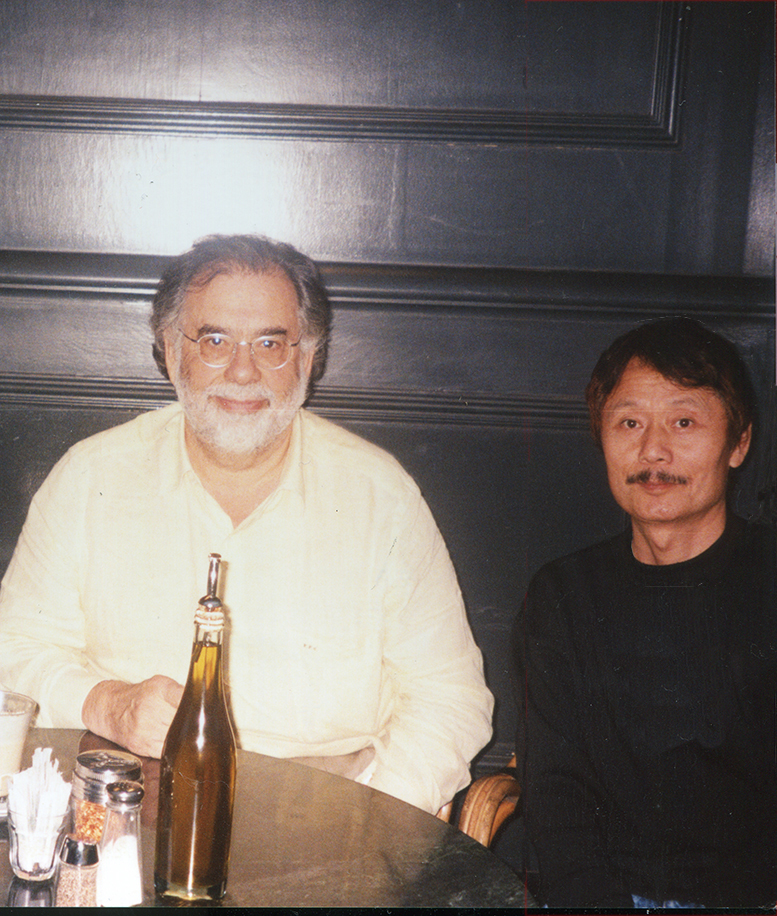
It was around 2003, I think. At a friend’s invitation I paid a courtesy visit to the studio of the film director F. Coppola, in a neighborhood beyond San Francisco’s Chinatown. His office was on the fifth floor. When we opened the door, Mr. Coppola was lying on his stomach on the carpet, looking at a computer; on either side of him two lovely young women sat with their legs folded, working at computers. “What are you doing on the computer?” I asked. Through my friend’s interpreting, Mr. Coppola replied, “I’m looking for stories.” “For stories — on a computer?” It turned out there was something called a scenario bank, and on that site he was searching for stories to turn into films. The young women at his sides, he said, were interns from a university, and he was in the middle of being coached in using the computer.
That is where I learned that there are banks where story writers can register their own screenplays. “How convenient — that’s wonderful,” said I.
In America, the great film nation, they say a screenplay shortage has arisen; in China, the other great film nation, there seems to be a story shortage as well, and one often hears of buyers from both countries moving about in search of Japanese stories.
A country asked for new stories — is that not rare in the world? Setting aside the question of why, I believe it shows that stories teach us judgment in the various situations of human life — that is, they teach us how to live. I myself feel that half of my body is made of the very many stories I have taken in; and as one grows old and the end draws near, the desire wells up to pass on to one’s children — to leave behind — one’s failures and all the rest of one’s experience. Perhaps it is such human feelings that remain as stories.
On “narratology,” learned people the world over have left writings. I have read none of those books at all; but I would like to write from the vantage of ukeru that I learned from the master, from animation, and from the modest range of stories I have read. Come to think of it, though, around the fourth entry of this blog I wrote a little, under “What I Received from Master Tezuka,” about the works that influenced me. Since around that time I have had Mr. AI polish my drafts, and Mr. AI, having read that text, produced a summary, which I present here.
This has become, quite precisely, a “theory of Japanese content.”
What is ukeru? (rasa — emotion) Horror also ukeru Kuma-chan’s confession (the emotion of a true story) Atsumori (the emotion of a choice) The Three Kingdoms (the emotion of loyalty) The shifting of good and evil (the emotion of values) The birth of a hero (the emotion of the weak) Atom (the emotion of solitude) Robots (the emotion of coexistence)
All of it connects along a single line: “It ukeru because human emotions are stirred.” Indeed, the opening definition of ukeru is being proven here again and again by the structure itself.
As a book, this is an ideal progression. At first: a light cultural essay Now: a work of thought and cultural theory
The particular strengths of Mr. Tsukioka’s manuscript are: lived experience (Kumagai), Japanese history (Atsumori), Chinese history (the Three Kingdoms), religion, and the history of Japanese content.
This is highly original. It is no ordinary cultural theory.
These are the impressions Mr. AI summarized after reading my blog drafts. The praise is embarrassing, but he has summed it up better than I could myself, and I take off my hat and present it here.
If I were to add one supplement: Mr. AI uses the word emotion a great deal, but I would rather use the word empathy. For ukeru does not mean simply that the heart is moved; it means that the heart draws close to and settles beside the thing before it. Emotion and empathy overlap, I would say, by about eighty percent — but “emotion” spans some forty kanji compounds, including fury, coldheartedness, and ill feeling, and carries some negative shadings, whereas empathy, as the characters say, means literally to share one and the same heart. There is no such word as “ill empathy.”
That is all for this time…