There is a small reason why I chose “experimental film” as the title this time. The name “experimental film” turns up often in the curricula and study groups of Chinese universities.
I’ve never actually looked into what exactly the term refers to in Chinese universities, but Japan certainly had an age that could be called experimental film, and the animation it left behind had its own influence — so my motive was simply to make it one of my topics.
In Europe in the 1910s there was an age of experimental film. It was part of the avant-garde (the avant-garde of cinema) that arose in the 1920s. As for where the avant-garde came from, there was the Dada movement that began in 1916, and if we go further back, we can trace it all the way to the second Paris World’s Fair.
As is well known, when Japanese culture was introduced at the Paris Exposition (1867), this art world so different from the European art that had come before became a stimulus, giving rise to the Japonisme movement and to Impressionism, which shook Europe’s traditional concepts.
Dada, which arose after the tragic First World War that followed, was a negation of common sense and political order, a negation of tradition and formal art; it began as a style of poetry and went on to create the currents of Fauvism, Surrealism, and Cubism in the novel and in painting.
Around the same time, a gentle tendency toward “the musicalization of the visual” was also stirring in the world of music, and Debussy’s (1862–1918) Clair de lune, La mer, Images, and Estampes are famous examples. Come to think of it, we had already brushed against a part of this in Disney’s Fantasia (1940). Disney had gathered the musical pieces (classical works) thought to be the most visual at the time, and was attempting a fusion — a collaboration of music and animation.
The Musical Pieces Used in Fantasia
- “The Rite of Spring, I. Stravinsky 1882”
- “Toccata and Fugue in D minor, J. S. Bach 1685”
- “The Sorcerer’s Apprentice, P. Dukas 1897”
- “Dance of the Hours, A. Ponchielli 1876”
- “Symphony No. 6 (Pastoral), Beethoven 1808”
- “The Nutcracker, P. Tchaikovsky 1840”
- “Night on Bald Mountain, M. Mussorgsky 1839”
- “Ave Maria, F. Schubert 1826”
The music comes first, and the animation unfolds in time with the musical pieces.
The “Toccata and Fugue” in the film was at first entrusted to Oskar Fischinger alone, it seems, but Disney found the imagery far too abstract and wouldn’t accept it. Fischinger was taken off the project partway through, and there’s no denying the result ended up somewhat half-finished.
Disney is said to have thrown his entire fortune and his finest talent into this work to take on the challenge. Among music critics there were extremely harsh assessments that he had cheapened and degraded classical music, but there is no doubt that he increased the number of people — myself included — who took an interest in classical music.
Going back even earlier, Richard Wagner (1813–1883) had brought to fruition on the stage The Ring of the Nibelung, which aimed at the unification of poetry, theater, fine art, and music. Once film was invented and spread in the 19th century, recordings of this on film were also left behind. The style of collaboration between music and story — later called the musical, and carried on mainly in the tradition of Disney Productions — surely traces back to Wagner; I think we can say that without error.
Just as there was visual expression through music, an age also emerged that aimed at musical expression through painting.
- W. Kandinsky (1866–1944)
- P. Mondrian (1872–1944)
- P. Klee (1879–1940)
- O. Fischinger (1900–1967) — animation
- N. McLaren (1914–1987) — animation
The people listed above were all aiming to turn music into images, and Fischinger and McLaren were the ones who carried out the collaboration of music and image after film had been invented as a medium.
Once the age of film arrived, painters seeking a place for their expression in it also began to appear.
Music is abstract to begin with, and Disney expressed it through concrete, representational imagery — but the individual painters all shared the characteristic of depicting it as abstract images.
McLaren left behind such a diversity of expression that one feels abstract expression through film was exhausted by him alone. Among his works are a handful with a narrative quality, and one of them — a masterpiece titled Neighbours — he left behind as pixilation.
Neighbours
In a peaceful setting stand two houses next to each other. The seemingly ordinary masters of both households are reading newspapers in their beach chairs. There is no boundary between the two lawns, but suddenly a flower grows up and blooms right around the dividing line. The man on one side, noticing it, pulls the flower onto his side and draws a property line. The man on the other side then re-draws the line so that the flower is on his side. The first man this time sets up a stake as the boundary, and the man on the other side drives his own stake in again. It escalates and escalates, until they use the stakes as swords and fight, and in the end both perish and become mounds of earth — graves. It depicts, in effect, the beginning and end of a war in six minutes of pixilation (a kind of stop-motion). The beginning of war comes down to either land or a flower (resources), and every war happening in the world today is exactly the same.
- Leo Tolstoy, War and Peace
- Catherine Merridale, Ivan’s War — A Record of Red Army Soldiers
- Toru Takagi, Document: The War Advertising Agency — Information Manipulation and the Bosnian Conflict
Each and every one of these is a long story that tells of war, but McLaren depicts it in just six minutes of animation that even a child can understand. It came into Japan in the 1960s under the category of experimental film.
McLaren and Japan
It must have been around 1972 or ‘73. Mr. McLaren came to Japan, led by his home country of Canada, bringing his new works Synchromy and Pas de deux.
There was a screening at the Sogetsu Kaikan next to the Canadian Embassy, and I too received an invitation and went to the hall. Ms. Kashiko Kawakita of Towa Film was already there. Or rather, the host was the Canadian government or the Canadian Embassy, and I could imagine that the arrangements for the Japanese invitees and so on had been handled by Ms. Kawakita’s Towa Film company.
It was probably the first time someone famous in the world of animation had come to Japan. Naturally, invitations to the screening must have gone out to Japan’s famous artists, but I heard that hardly any of them had shown up — and also that the Japanese side had made no preparations whatsoever (no place to host or entertain him) for Mr. McLaren.
“Oh dear… let me reach out too.” The next day I took the liberty of telephoning my various seniors, suggesting, “Couldn’t we at least set up one banquet, just for the people in the animation world?” — but perhaps because it was all so sudden, I couldn’t get a good answer.
With no other choice, I called on close friends. Five of them agreed: Mr. Takehiko Kamei, Mr. Sumio Gotoda, Mr. Kosei Ono, and Mr. Yasuhiko Suzuki, all of whom had spent a year studying abroad at the NFB (the National Film Board of Canada), and Mr. Carlos Marchiori, who had moved from the NFB to Suntory’s advertising department. And so I made a reservation at Jisaku, an old Japanese restaurant in Tsukiji.
For our side, I asked Mr. Kosei Ono — a director in charge of English conversation programs at NHK — to take part and double as interpreter. Meanwhile Ms. Kawakita had recommended Mr. Don Kelly, an American kyogen performer who was both actor and writer, as interpreter. So, lavishly, we had two interpreters. But the only ones poor at English were myself and Mr. Suzuki, so it became one-on-one conversation.
Jisaku entertained us splendidly. For the event, a geisha in men’s attire even performed the Kuroda-bushi dance, swinging a long spear around — which was wonderful, though since it was a weapon (?) after all, Mr. McLaren showed a flinch or two, and the man dispatched from the embassy made exaggerated gestures as if to shield him, drawing laughter — I can still recall it.
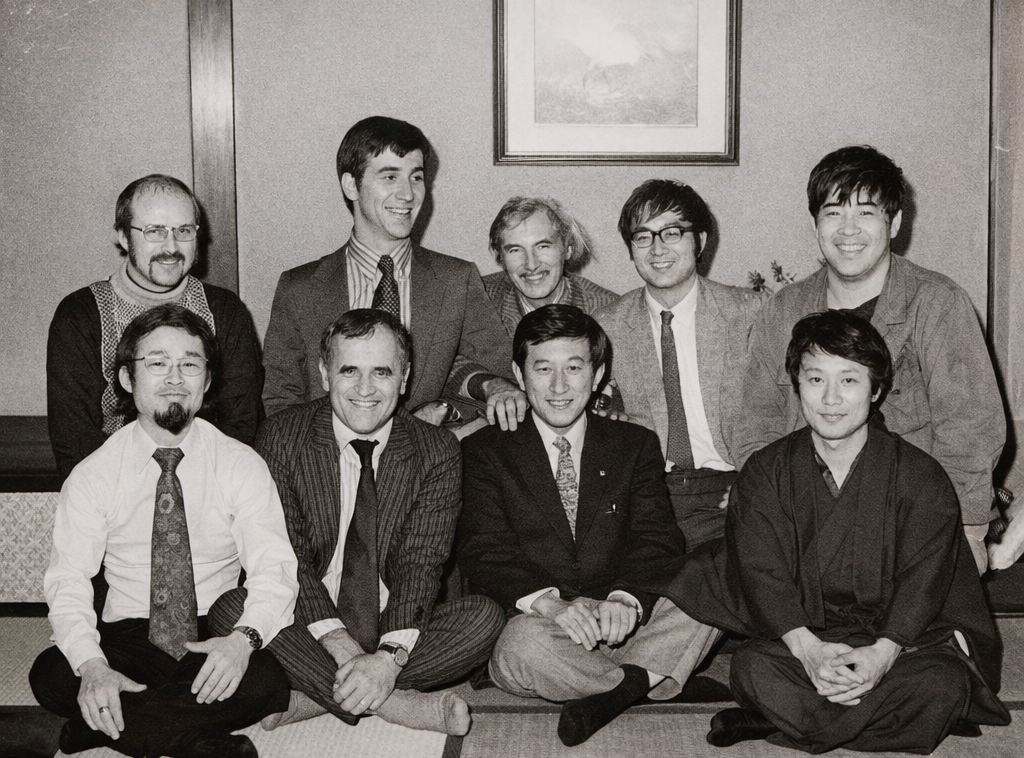
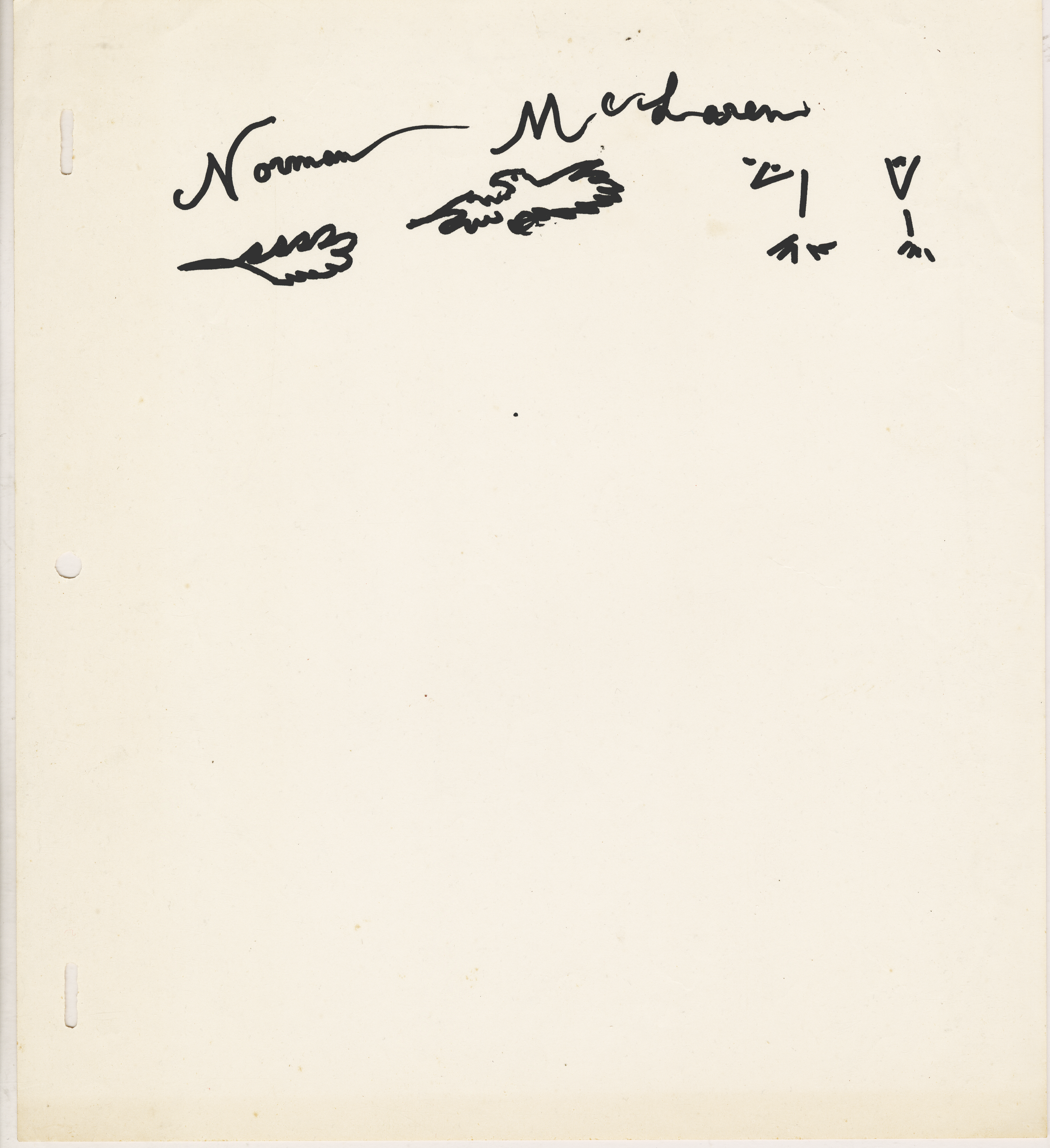
At the very end, I had Mr. McLaren draw one of his specialty rooster pictures for me, and I treasure it as a prized possession. The hosting ended without a hitch, and afterward Ms. Kashiko Kawakita thanked me as though it had been her own affair, leaving me quite humbled.
Afterward, I too had the chance to be invited twice to Ms. Kawakita’s dinner gatherings. Looking back now, I’m truly glad I took the plunge and arranged that welcome banquet.
We Really Should Teach About War
The United Nations, mocked as dysfunctional, ought to send this McLaren film Neighbours to every elementary and middle school in every country, and show it as an aid to teaching about war. It would be even better to gather the world’s presidents and show it to them. It is my strong proposal that the Nobel Peace Prize should be given to none other than Mr. McLaren.
The term “experimental film” derives from the experimental film workshop founded by Lev Kuleshov (1920).
- Hans Richter, Rhythmus 21 (1921)
- Luis Buñuel & Salvador Dalí, Un Chien Andalou (1929)
- Kenneth Anger, Fireworks
- Oskar Fischinger, Motion Picture (1947)
- Len Lye (1901)
- Norman McLaren, Begone Dull Care (1949), Neighbours (1952)
In the 1930s those avant-garde or experimental films were introduced into Japan, and there is a history of Japan producing a number of experimental filmmakers of its own. By the 1950s, along with many experimental films, limited animation also began to come in.