Now, when it comes to ensemble drama, the first thing that springs to mind is that masterpiece of the Hashimoto–Kurosawa pairing, “Seven Samurai.” The individuality of all seven was drawn without a scrap left over. A human quality unlike anything fabricated, the kind you might find anywhere in the real world, comes pouring out of it. Reality was the window through which empathy entered.
There Were Two Miyamoto Musashis in “Seven Samurai”
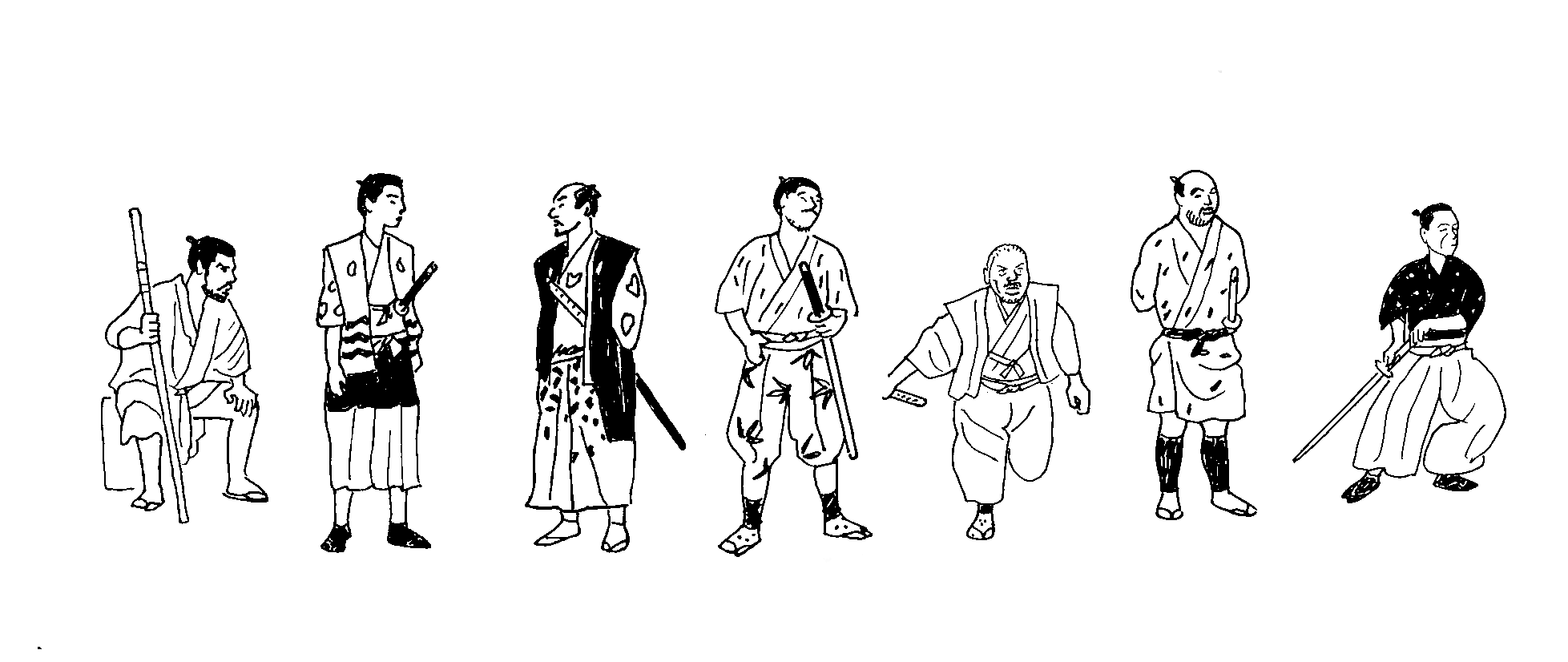
- ① Yoshio Inaba He sees through the trap that the leader Kanbei sets to test his skill, and even so, feeling empathy for Kanbei’s character, joins the fight — a properly samurai-like man.
- ② Daisuke Katō A master of the long spear; a samurai with the pride to fly into a rage at the villagers’ attitude toward defeated warriors.
- ③ Isao Kimura A young samurai not yet through his coming-of-age rite. There is a device by which the portraits of the others are drawn through his eyes.
- ④ Takashi Shimura The leader, a veteran of a hundred battles who lived through the age of civil war; he shows a gentle nature, but the figure he cuts as he moves toward his objective is severe.
- ⑤ Minoru Chiaki Bright and easy with people, never turning grave even in hardship — an important type in a story.
- ⑥ Seiji Miyaguchi Humility itself about his own work, and a man of few words; he lets you sense he is the finest swordsman of them all.
- ⑦ Toshirō Mifune The only one not born of samurai stock, and carrying a complex because of it — a wild man.
(Here I have deliberately used the actors’ names rather than the characters’ names.)
⑦ is Miyamoto Musashi in his younger days — hot-blooded, a wild man.
⑥ is like the Musashi of his middle years, grown quiet.
The screenplay of this “Seven Samurai” was bought by America and filmed there as “The Magnificent Seven” (the Mirisch Company & Alpha Productions). Sequels followed, some six pictures in all made in America; but the roles of ④ and ⑦ were collapsed into a single man and built up as the hero, so you could say the interest of the original was cut in half.
Do they not understand what makes an ensemble drama interesting, I wonder — is it the habit of hunting peoples and herding peoples, who needed a hero, or perhaps a convention in which the Jungian hero-ism and the star system of American movies came together? Even so, I do not mean to say that every story ought to be an ensemble drama. Finding an ensemble interesting may itself be the habit of a farming people…
And what of the American animation companies that go looking for stories? True enough, the Disney studio’s recent “Toy Story” has come as far as a fourth installment in the ensemble-drama style, and “Despicable Me” (Illumination, 2010) is, I suspect, something that emerged out of the image of Japan’s “Lupin III” (1968, Monkey Punch).
That Lupin III came from the French “Arsène Lupin,” the novels of Maurice Leblanc; but once it arrived in Japan it transformed into an ensemble drama, and when it returned again into the hands of a Frenchman, Monsieur Pierre, it changed its name to “Gru the Thief” and showed the elements of an ensemble drama. In the Gru series the Minion horde is more popular than Gru, the main character, and the trend is that more and more of the spin-offs put the Minions at the center.
This is a fine example of the audience making the story. Illumination was founded in 2007, so it is a very new company, and the works it produces and its animation technique are solidly built — but it nags at me that every character shows the same timing of movement. As an ensemble drama, I feel its hand has not quite reached as far as the individuality of the characters.
In early spring of 2026, when I met Mr. Pierre Coffin, one of the directors of the Gru series, at PH Studio in Nakano, I asked him about how the characters are positioned and so on; perhaps I asked it badly, but I did not get a clear answer.
This blog began with anime at its center, but its great theme is ukeru — appealing to audiences, catching on. What is ukeru? I have been shining a light on the things that caught on as big hits in the past and looking at where they came from and how they were made; now I would like to turn my eyes a little to things outside anime.
To give the representative examples, there are the things NHK loves — “Chūshingura” (the tale of the forty-seven rōnin) and “Taikōki: Toyotomi Hideyoshi” — which have been made over and over since television first went on the air under the name of the taiga historical drama; and on TBS television there are “Mito Kōmon,” whose ultra-long run goes on and on, and “Ōoka Seidan.”
The Merits and Crimes of “Mito Kōmon”
There is a model behind “Mito Kōmon”; it comes from the invented novel that arranged that model, “Mito Kōmon Manyūki” — the record of Kōmon’s wanderings. This is my own reading, but I suspect that the leading man who assembled a plot for the movies on the foundation of the anecdotes surrounding the Qing dynasty’s Kangxi Emperor was Sanjūgo Naoki, known by name from the Naoki Prize.
In the early days of film a series of fourteen pictures was made starring Ryūnosuke Tsukigata. Counting films, novels, plays, manga, anime, and stage productions together, the total must comfortably exceed a hundred. And what is most tremendous of all is the TBS television series. Counting the terrestrial broadcasts from 1969 into the 2010s, and the satellite broadcasts after that, the sum works out to more than 2,600 episodes produced. Popular content supported over so long a span must be rare anywhere in the world.
The skeleton of the story is frighteningly simple.
An old man who conceals his true station as vice-shogun travels the provinces with two able retainers in tow. At each stop he becomes acquainted with common folk at their wits’ end and offers to settle their trouble. But the other party is invariably a crooked local merchant or the local magistrate, on rare occasions an outside daimyō, or else a violent organization, or a power structure in which those are all in collusion.
The party storms the villains’ stronghold and thrusts out the inrō case bearing the triple-hollyhock crest of the Mito Tokugawa house. At the single line “Do your eyes not behold this crest?” the scoundrels prostrate themselves; but before long they fly into a rage, turn their blades on him, are cut down in return, and are taken in a single sweep. That is the motif.
Once, when I spoke about this structure in a talk, a voice came from a Chinese exchange student in the audience — a young woman: “That is the same story as our Kangxi Emperor.” The same as “the fourth Qing emperor, the Kangxi Emperor, 1661.” In a hurry I went digging through material on the Kangxi Emperor myself. And indeed, among the emperors of China he was one of the popular ones, vying for first or second place with Taizong of the Tang. Chinese television turns him into a program now and then, and the videos were sold in Japan as well.
The Kangxi Emperor, in the Ming era, cut the number of officials working in the Forbidden City (the center of politics) from ten thousand to a hundred; he took one day’s share out of the 365 days of annual expenditure of that same Forbidden City and made it the expenditure for a whole year; and he labored at tax exemptions and tax reductions — all of which are highly regarded. He carried through to completion the flood-control works on the Yellow River, which so often floods, and on top of that encouraged culture and learning and worked to spread Zhu Xi’s Neo-Confucianism. Further, he made six southern tours (the equivalent of the Japanese junkō — a junkō being when the emperor of our country travels about to see the various regions).
A southern tour, it seems, points to the emperor going to the south of China, around Shanghai, Zhejiang, Hangzhou, and Anhui. This fertile belt had long prospered in agriculture and commerce and been rich in culture and learning, and so he carried out on-site inspections there several times; and from the figure of a wise ruler who attended to river management and listened well to the people, it is surmised, a great many popular tales were born. These were transmitted to Japan, dramatized by Sanjūgo Naoki, and came to fruition, did they not, in the character of Mito Kōmon.
In this same period Ryūnosuke Akutagawa and Osamu Dazai, too, wrote several translations — or rather adaptations — out of the “Liaozhai Zhiyi,” the strange tales handed down in China, so there must have been an atmosphere of kankotsu-dattai, of recasting the tales of the East down to the bone.
In fact, before our Kōmon-sama, Korea had already produced a tale called Amhaeng-eosa — the secret royal inspector — and today a great many television shows, anime, manga, and games of that same name are appearing; this too was Kangxi-style content. Look a little into Korean history and its coloring seems to differ considerably from both Japan’s and China’s.
In Korea, too, it has now become “The Joseon Secret Investigation Corps” — in short, a spy organization of the Yi dynasty of Joseon; it was a real post, one that watched how the people regarded the government and secretly inspected the misconduct of provincial officials. But in the creations of later ages it was sublimated, just as with the Kangxi Emperor and Kōmon-sama, into that exhilarating format in which one conceals one’s station and chastises evil. As is well known, the historical Mitsukuni of Mito never in fact wandered the provinces.
Japan being Japan, it has been said since the old heyday of the movies that Kōmon-sama, too, has plenty of problems.
Ever since the heyday of the movies, the deception carried within this story structure has been pointed out. The common people never resist power themselves; they simply wait for a still mightier “Authority” to descend and solve the problem for them. This is nothing other than a facile way of discharging the ressentiment (the envy of the weak) that the weak carry. To anyone who objects that the explanation of ressentiment is too simple, let me add a slightly harder one: it means “the conversion of the weak’s repressed sense of powerlessness and rancour into some other value judgement. — F. Nietzsche.”
One more thing that nags at me: every time, Kōmon-sama makes his entrance before people he is meeting for the first time with his station concealed. He is laying a trap — a torappu, a wana. Once he says of himself, “Know that I am the highest power in the land,” the scoundrels, realizing that their true substance has been witnessed, prostrate themselves. And the good folk (the weak) turn on him a kind of envious gaze, confirm the proof that they had been in the right all along, and are relieved.
It is true that you often see the sort of person who bows and scrapes before those with power, before the boss at work, and is arrogant toward his subordinates; there must be a pleasure in watching that changing-over. But Tokugawa Mitsukuni was a man who, in his thirties, invited the Ming Chinese scholar Zhu Shunsui (aged sixty), studied Confucianism and Zhu Xi studies under him, established the Mito school, and labored at the compilation of the Dai Nihonshi (the History of Great Japan). Zhu Shunsui had fought the Qing alongside Koxinga (Zheng Chenggong), fled to Nagasaki after the defeat, and, at Mitsukuni’s invitation, became the teacher of Mito learning.
If you ask what I am driving at, it is that Tokugawa Mitsukuni was a man accomplished in both letters and arms. That such a Mitsukuni should stroll about here and there, laying traps and amusing himself with them — he would hardly have been a samurai of so thin a dignity as that. That is what I want to say.
Kōmon, the central figure of the tale, is the agent (the vice-shogun, the proxy) of the greatest power of all (the shogun, the ruler). What produces the petty villains who swagger and run rampant out in the provinces is none other than the shogunate’s own structure of rule. Without ever turning an eye to the fundamental fatigue of the system or the incompetence of the ruler, one takes a momentary catharsis from the violence with which the petty villains are punished on screen, and is satisfied. Every one of those petty villains, appearing without limit, is an avatar of the ruler.
One leans on tariki hongan — not in its proper Buddhist sense but in the colloquial one of “leaving it to others” — and affirms and endorses the status quo in the spirit of “good fortune comes to those who wait in bed.” For the ruler it is extremely convenient; for the common people it becomes a tranquilizer; for the makers it is a pre-established harmony, easy to mass-produce. It was, so to speak, a mechanism of “no loser among the three parties.” An ironic tale — and yet in 1979 it knocked out a peak rating of 47.3 percent.
Having written this far, something must already be visible: “What’s with this fellow — he calls it big content and then turns awfully critical,” you must be thinking. The fact that it was a huge hit and whether one can praise its content uncritically are separate questions. I am not throwing up both hands in sympathy with this structure. But this, precisely, is the cold, hard face of the phenomenon we call ukeru — catching on.
Chūshingura
This too, alongside “Taikō Hideyoshi,” is material — or ingredient — that NHK dearly loves. One such national killer content is “Chūshingura.” In the 1964 taiga drama “The Rōnin of Akō,” the episode of the raid recorded a peak instantaneous rating of over 53 percent.
My own interest in both the “Taikōki” and Chūshingura is thin and I do not know them well; but the prototype of this Chūshingura is a story written by Monzaemon Chikamatsu and others on the basis, more or less, of historical fact, and it is the ensemble drama par excellence, so I cannot simply walk past it and would like to look at it a little. Incidentally, several authors besides Chikamatsu have written it.
Japan has what are called the three great revenge dramas. One is this “Chūshingura”; the second is “The Vengeance at Kagiya no Tsuji”; the third is “The Vengeance of the Soga Brothers”; and as a plus-alpha there is “The Duel at Takadanobaba.” This alpha is colored differently from a revenge piece — it is a coming-to-the-aid piece. The first two have often been turned into films and television shows since the age of film and television arrived, and the second one, Chūshingura, has become NHK’s household art.
Since it is a revenge drama carried out by no fewer than forty-seven samurai, one imagines there must have been some enormous grievance behind it — but in fact the cause of the quarrel is not altogether clear. What was the cause of the fight between the Akō domain and the House of Kira? Presumably it is because the interpretation of this point differs from work to work and from author to author. Take a story called one of the world’s epics — the “Iliad,” for instance.
The tale depicts the war of Agamemnon (Greece) against the armies of the kingdom of Troy (around Turkey); but as for how the thing began, it was a story that swelled into a great war because Paris, the second son among the princes of the kingdom of Troy, carried off Helen, the wife of King Menelaus of Sparta (on the Greek side). The ancient Indian epic the “Ramayana,” too, has its story set in motion by the abduction of the beautiful Princess Sita, the wife of Rama, prince of the land of Kosala, by Ravana, the king of the neighboring country (present-day Sri Lanka).
Many ancient tales took as their point of departure the carrying off of another man’s wife. Honour and jealousy, and the feud over a woman, seem to have been absolute motives, enough to start a war.
The “Iliad” is a popular tale in the Euro-American world and has been filmed several times; likewise the “Ramayana” is one of the popular bodies of content in the Indian world, with film versions, picture books, and novels beyond counting.
Well, the motive of these stories is clear, so they are easy to grasp; but over here Asano did not carry off Kira’s wife, and the motive of Chūshingura is hard to make out after all.
The Fight Between the Akō Domain and the House of Kira
Ever since the age of the movies it has begun with the incident in which the lord of Akō, Asano Naganori, slashed with a short sword at the master of ceremonies, Kira Yoshinaka, in a corridor of Edo Castle — the equivalent of the Diet — and from there it becomes a grand ensemble drama; but “why on earth did he go and do a thing like thaaat?” Asano, as he cut with his blade, seems to have said, “Do you remember this grudge?” (a deep resentment) — but as for what the source of the resentment was, not even the historical materials tell us any further.
One can imagine it was probably bullying, the sort of thing social media excels at, or power harassment, or plain spite; but as for what purpose? — that is In a Grove, that is Rashōmon.
In terms of formal rank, Kira was a kōke hatamoto — a bannerman of the ceremonial houses — of Junior Fourth Rank, Upper Grade. Asano, though a daimyō of fifty-three thousand koku, was of Junior Fifth Rank, Lower Grade, so in the order of status Kira stood above him. In economic power (kokudaka), on the other hand, against Kira’s four thousand two hundred koku Asano was a daimyō of more than ten times that. You can fairly smell the tinder where complex and pride grind against each other; it comes buzzing at you. Yet most creators have not gone very deep into Asano’s short temper or his mental lopsidedness, fashioning the thing purely as an emotional tale of loyalty instead — which is, I suppose, where it stands up as one of the set conventions of the traditional performing arts.
Kira, whose role was to preside over the ceremony, must have had a certain standing of his own, so it would not be at all strange if he had run to bullying. Asano, on the bullied side, with more than ten times the stipend, must have had high pride — and moreover there is a theory that Asano was of the eccentric, short-tempered type. What sort of conflict there was in this battle of pride and complex ought to depend on the skill of the story’s creator, but most authors seem to take care not to go in too deep here.
Since this incident came some hundred years after the age of civil war, even a samurai would have had no experience of fighting with a live blade — but here there was one man, and only one, who was a genuine swordsman: Nakayama Yasubei. Why genuine? Because Horibe (formerly Nakayama) Yasubei, the hero of the plus-alpha vengeance tale mentioned above, “The Duel at Takadanobaba,” was a samurai who in the duel of that title had already cut down three men or more. And by what karma one cannot say, but seven years after the Takadanobaba affair he took part in the raid on the Kira residence as well.
Counting both sides, friend and foe, this man was the only one with experience of combat. On Kira’s side the dead apparently numbered sixteen or seventeen. Besides Horibe Yasubei there is one more figure who plays a great part: a man called Takebayashi Tadashichi, said to be a descendant of Mencius. His grandfather, Meng Erkuan, was a Chinese man from Wulin county in Hangzhou, in Zhejiang. Look into it and the cast is complete with players who carry a narrative of their own. This was content that could not help becoming a grand ensemble tale.
Still, let us taaag it: this national content, too, is a story that takes ressentiment for its nourishment.
“The Count of Monte Cristo” and the Dynamics of Jealousy
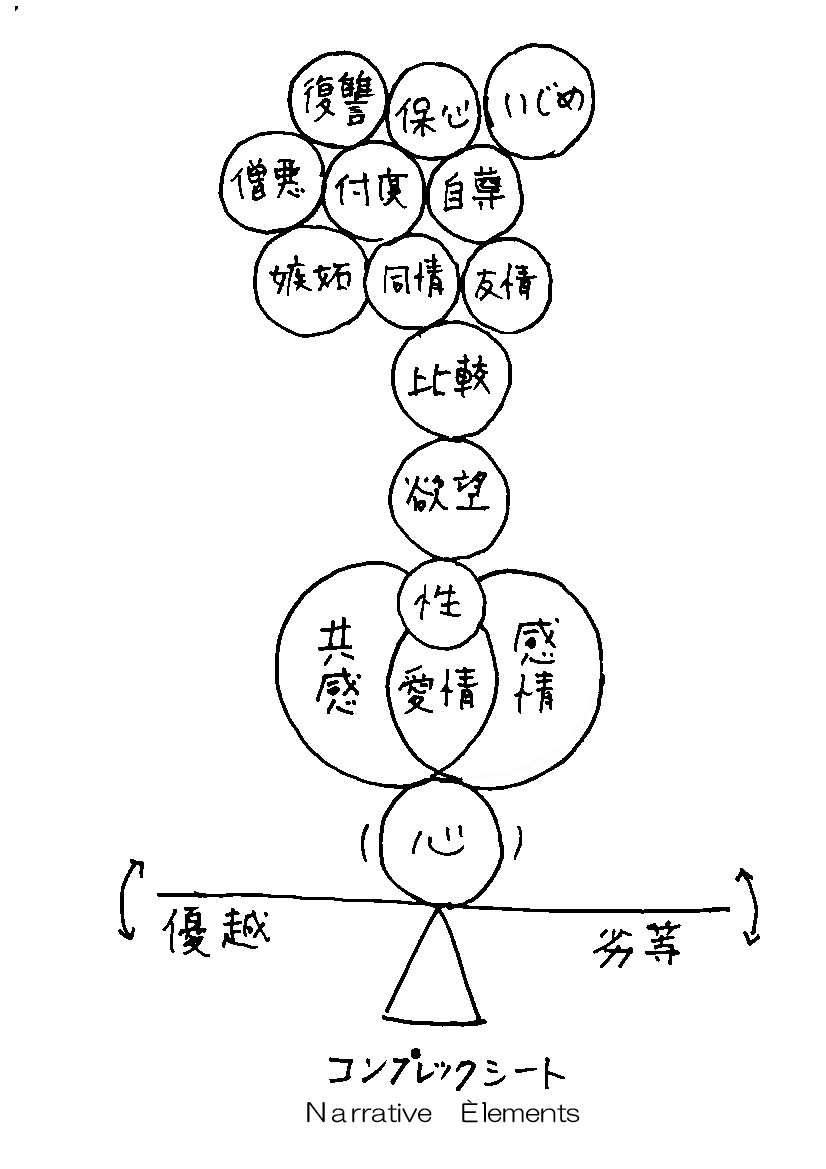
The story among stories, held to be the monument of the revenge drama — “The Count of Monte Cristo,” by Alexandre Dumas (1846–) — draws the motives that drive toward ruin in fine and cruel detail, in contrast to Chūshingura. This too, like Chūshingura, is a revenge drama based on a true account. Edmond Dantès, a promising young navigating officer, was shining: his promotion to captain settled while he was still young, his marriage to his beautiful betrothed Mercédès close at hand. But that happiness pulls the trigger on the warped feelings around him.
- Fernand A friend, but he covets Dantès’s sweetheart Mercédès
- Danglars Jealousy at the advancement of the younger Dantès, and the collapse of his pride
- Villefort Deputy prosecutor. Self-preservation, to conceal the evidence of the treason in which his own father is involved
- Mercédès Dantès’s sweetheart
- Albert The child of Fernand and Mercédès
The captain suddenly dies of illness, and the shipowner names as his successor Dantès — nineteen years old, young, straightforward, and good at the work. Here the heart of Danglars — the senior sailor, and his senior in career as well — grows complicated. Not only will he be unable to hold his head up before a young whelp of a captain junior to him; it is easy to foresee that in pay and standing too the man will overtake him, the boiling point of his jealousy is rising, and his pride is in tatters.
He incites Fernand, and it comes to the secret writing of a letter of denunciation. He works on the deputy prosecutor Villefort besides; Villefort, out of political self-preservation, is in want of a scapegoat, and the three-in-one plan to bring Dantès down is complete. And so Dantès was made to spend fourteen years of prison life in the Château d’If (If Castle) on the island of If.
Come this far and you will see that the beginning of a story is set in motion by people’s desires, pride, jealousy, self-preservation, and the like. The intensity of a revenge drama is proportional to the persuasiveness of the malice and the motive at its origin. Shakespeare’s “Hamlet” and “Othello,” too, were driven as drama by jealousy and suspicion.
The philosopher Kiyoshi Miki, in “Notes on Life,” grasps jealousy as “displeasure at another’s happiness or superiority, and the anxiety that it may be taken away,” and points out that it is the most troublesome vice there is for a human being. The strength or weakness of a revenge drama lies in the strength of this motive. Set against it, does not the thinness of the motivation in “Chūshingura” stand out?